Articles Index
16. THE LINEFISH RESOURCE ENVIRONMENT (2021/22)
15. RECREATIONAL FISHING PERMIT CONDITIONS (2022)
14. REGULATIONS FOR ARTISANAL FISHING (SO CALLED) 2022
13. THE ENIGMA PROJECTED BY MARINE PROTECTED AREAS, (MPA) 2022
12. MARINE SEISMIC SURVEYS AND TERRESTRIAL FRACKING (2021)
11. THE FAILURE OF THE 2020 FRAP (2021)
10. THE SASSI INITIATIVE (2020)
9. FOREIGN TRAWLER ACTIVITY IN SA’S WATERS (2021)
8. THE SARDINE RUN BAN (2021)
7. MARINE RESOURCES: SOME OF MY CONCLUSIONS (2019)
6. THE SEARCH FOR UNDERSTANDING (2019)
5. WHO SHOULD BE ALLOWED TO CATCH WHAT (2018)
4. THE FISHING INDUSTRY AND ITS RESOURCES FUTURE (2017)
3. INSHORE RESOURCES. (2015)
2. A PREDATOR OF THE PAST? Meeee?? – (1995)
1. TRAWL BY-CATCH – (1989)
10. The SASSI Initiative (2020)
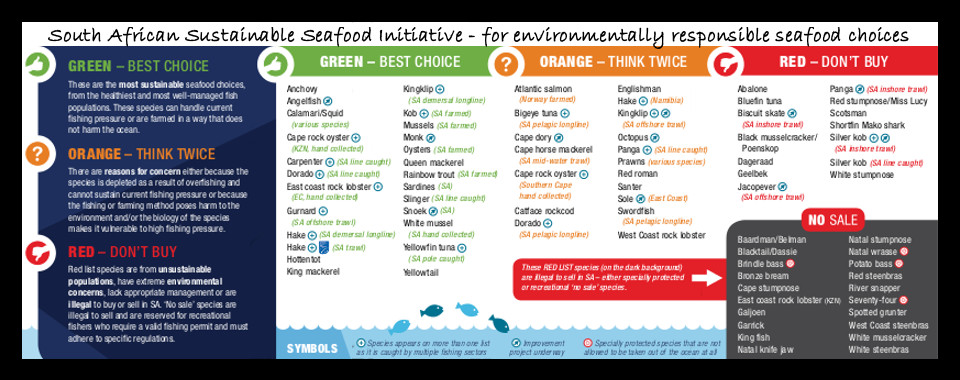
Under the auspices of the WWF, the Southern African Sustainable Seafood Initiative came into being in 2005. It mirrors similar overseas Initiatives of the same calibre. It purports to rate seafood produce in relation to the individual resources or species sustainable strength, recommending to consumers as to whether such resources are in good health and well managed, or over fished, or fully protected, to prevent their possible demise. I have great reservations as to its effectiveness, accuracy, and practicality.
This is not to say that I do not support the overall principle of what they wish to achieve. I am in fact entirely in favour thereof, particularly if it will assist in reducing the illegal catching and sale of fish species that for the most part are under very real threat. These should be listed by the regulations, as most are, as species that may be caught only by Recreationals but never sold! Obviously, their exploitation will be subject to strict conditions.
Over the years, I have criticised this list in a manner that I believe has always been supportive, proactive, and logical; never negative towards the initiative in any way. However, I have never had any response to this and other articles, positive or derogatory, from SASSI, the Fisheries Department, Business, or any Recreational body. This list, aimed at the general public, retailers and restaurants, should be a very valuable tool towards protecting our inshore marine line-fish resources and other related species. Its supporters claim that many use the list continually, but I am aware, through my connections, that many more, including retailers, laugh at them pointing out the anomalies, inaccuracies, and conflicts with existing regulations, let alone pure logic.
The real truth of the matter is that the whole question of what you can and can’t do is a very complex one to overcome and, as such, there can be no perfect answer. So, accepting that your lists can never be spot on, base them on the best logic as simply as possible. Then the greatest number of our peoples can easily relate to what you are recommending without confusing the situation as they presently do!
Perhaps you should know that I am 83 years old, and, for 77 of those years, most of what I have done and achieved has been on, around, or related to the marine environment and its resources. I only retired from my last business in 2014, and then ceased my recreational fishing as well.. I spent many of those years as a skipper mainly in the Pelagic Purse-seine Fishery. However, I have also personally fished the following industry sectors: inshore line-fish, inshore trawl, crayfish, tuna including pole caught, as well as inshore and offshore crustaceans, both locally and in four other African countries. Perhaps, as important as my experience, is that from the age of twenty the layman’s study of the Marine environment, its species, biodiversity, and its management towards sustainable exploitation, became my lifelong hobby.
I believe that, in a country as poor as ours with so many unemployed, neither yourselves, myself, or anyone else, should you be allowed to try and negate an individuals legislated right to earn a living. As a result, despite putting you in conflict the Fisheries Department, many simply ignore the List, and its potentially very important message.
Please ignore three of your continually harped on points – the method of catching – farmed or sea caught bycatch reservations. It has been reliably estimated that more than 50% of all edible fish landed are caught by bottom trawling with bycatch, and a so called, but mostly unproven and insignificant, level of damage to the seabed environment. How would you replace that needed protein in an already underfed world population? Let the scientists and Government Authorities all over the planet deal with those problems, of which they are well aware! Then, to add to your list’s confusion, you wish to ban or reduce landing of only some trawled species, but with the majority allowed! Lastly, who the hell knows what is farmed, wild caught, or obtained from any other production source. Certainly not the man in the street who must be your main target, and almost certainly not many of the restaurants nor many retailers!
Let us now start with the Red List, which should be confined to non-saleable, or fully banned species.
Until science can properly evaluate the current state of any specie, it is clear that decisions made about its abundance must be cautiously handled towards a safety-first approach. However, the question of the “Seventyfour’s” resource is a prime example of how this can be overdone. No scientific evaluation has been done, as far as I can find, since its landing was banned some forty years ago. Anyhow, it’s scientific evaluation is basically impossible, if it has not been predated upon. At least anecdotally, it is more than sufficiently abundant today to place it on the Recreational Primary (nonsaleable) list. Five years of statistical records and other methods of research would then give us a true picture, allowing one to modify their approach to its exploitation!
Nearly all the other items are either part of the Non-saleable Recreational catch-list, or are not targeted intentionally, nor sought after as edible fare. Their landings as bycatch are insignificant, and their resource mass unknown in SA waters, so it is unnecessary to list them at all. Certainly, please include the Recreational catch list, but properly identified as such and not in Red. In this way you will be doing everybody a very worthwhile favour education- and compliance-wise, let alone to the benefit of the fish!
In the case of every list, you must be free to use your own judgement to determine logical changes from those legislatively published by Branch fisheries, which clearly demonstrate illogical and faulty determinations. However, currently your lists evidence a wish by whoever created then, to populate each with as many specimens as possible. This is not helpful, and only creates both confusion and derision leading to too many of the public simply choosing to ignore them.
Let us now deal with each in detail as I would like to see them.
Your existing Red list mainly consists of fish that appear on the Recreational allowable catch list, all of which may not be sold by them. Please do not duplicate entries, which only causes confusion, unless another list includes them for the opposite reason, i.e. they can be sold. Also, do not include species that are not intentionally targeted, nor are normally edible fare such as Ragged Tooth Shark. However, from the Recreational Prohibited list you should include Brindle Bass, Coelacanth, Natal Wrasse, Pipefish, Seahorses, Potato Bass, and Wreckfish, as well as East Coast Rock Lobster.
I have no problem with your Orange list, but please be careful in getting the right advise from reliable sources, before you list a specie. For instance, it is completely pointless to place on such list species that Branch Fisheries deems as commercially viable to be caught by all sectors predating on inshore line-fish, such as Roman, Rock cod, Red and White Stumpnose, Red Steenbrass, Silverfish, (Not Carpenter, the general public do not know them by that name.) and from what source does the suggestion they are over fished emanate, which is anyhow rubbish, Bluefin Tuna, which are hardly caught in SA waters, and are not threatened here, Shad/Elf, Kob and Geelbek, Dageraad and Englishman which are on the Recreational list, King Mackerel, King Soldier Bream (what are they??), Kingklip, what nonsense they belong in the green column, various Kob species, pointless and confusing to list them here as none of the general public identify these sub-species as to them all Kob are just that Kob, Langoustine are not under any kind of threat as they are simply difficult to trawl or catch, Marlins and Swordfish, not threatened by over-fishing, and seldom intentionally targeted in SA, Poenskop are on the Recreational list, Prawns are not under any sort of threat so it is rubbish to place them on this list, Red Steenbrass not under threat, nor Romans, Rock Cod, Slingers, Snappers, nor Scotsman, Sharks the only ones targeted commercially are not under threat, neither are the rest anyhow, Scates and Rays are not under threat, Sole lastly is a limited complex resource, because you cannot exclude it from inshore bycatch. However, it is carefully monitored by the authorities with the only problem being that too many licenses are granted to catch same. You cannot, however not list them in the green section. There are some bad anomalies in the Branch Fisheries Commercially catchable line-fish list which you should choose to correct. For instance, it is utterly useless and unnecessary to limit the number of hake Fishers may land, yet they put no size limit on them, which should be 50cm. Otherwise the amount of hake caught by Line-fishers is absolutely insignificant. They should not be allowed to target and sell Tuna species at all, nor be allowed to catch one of any species when they are deemed to be under threat of over fishing. As such, the following species should only be allowed to be caught by Recreationals and you should add them to that list, if they are not already there!! These are, Dageraad, Poenskop, Scotsman, Englishman, and any Rockcod. Limiting Kingklip to only one is quite unnecessary and all commercially allowable catch should have minimum size limits. There is also no need for numbers limit on Squid, as long as in the whole bay area where they are mainly caught from the Cape Recife light to Cape St Francis has any sort of Boat fishing banned.
“Abalone” is a difficult question and highlights the many unavoidable problems encountered with your overall Initiative. Everyone knows it is potentially under threat. However, there is a strong belief that in many quarters that it has not returned to shallower waters due to illegal exploitation on a massive scale. Despite this, as a resource it has proved very resilient, and the Commercial dive quota remains. Furthermore, a large and growing aquacultural industry exists. For the public to identify the difference between specimens illegally as to commercially harvested legally, and artificially grown, is impossible, and, because so much today is commercially grown, it must be placed on the Green list.
Now to the Orange list; forget about Abalone for the reason I have indicated above. Omit Bluefin Tuna which are firstly not under threat, nor targeted intentionally in South Africa, let alone normal fare for consumption here. The same goes for Shark and most of the other species which appear on the Recreational list. It is quite incorrect to suggest that Silverfish (Doppies), Elf, Geelbek, Kob, King Mackerel, Langoustine, Marlins, Swordfish, Prawns, Red Steenbras, Roman, Rockcods, (why are Potato and Brindle Bass even mentioned here), and Snappers. Their resources may no longer be at previously pristine strength, but that does not mean that they cannot be sustainably predated upon. Anyhow, in this context what does Caution mean. You have no right to prevent legally listed and well managed species being sold for so many reasons. Just as an example of the confusion this causes, West Coast Crayfish is hopelessly overfished, yet, though quite rightly I believe, you put it on the Green list. Then, Is there any need for a Cautionary Orange list?
All I ask of SASSI, is to please be pragmatic. Please don’t depart from your chosen path, but equally please don’t confuse the public at the cost of legitimate industry, and the jobs they create, as well as the public’s right to choose correctly. Below is their current listing, which I have dissected through my admittedly limited layman’s scientific knowledge, but with significant anecdotal experience and logic. Only deal with edible fish or other marine species caught in waters off our coastline, with the one exception of northern hemisphere salmon because we import so much. All other imports are insignificant in amount, and as a percentage of their source’s biomass. Other countries must deal with their own problems. Only deal with edible species that are sold, or not allowed to be sold. Forget about the Orange list, but replace it with the Recreational list.